September 2026 rule transition
Official v1.1: through September 9 · Official v2.0: published September 3, effective September 10 · Official Q&A. These explanations do not supersede those sources.
SC8: choose the event context
- Through September 9: seven Scored Pins and three qualifying Goals.
- From September 10, standard events: six Scored Pins and two qualifying Goals.
- From September 10, events qualifying directly to Worlds: seven Scored Pins and three qualifying Goals. Worlds itself may receive a later update.
All thresholds apply at the end of Autonomous and require no Autonomous Violations. Each qualifying Goal must contain at least two Pins Scored for the Alliance. Pins and Goals in Quadrants on the opposing side of the Autonomous Line do not count. Neither Robot may contact the Field Perimeter. Use SC3's Scored status, not merely physical placement or a count of whole bicolor objects.
SG12: Endgame
Through September 9, a Robot at least partially in Midfield must make an effort to limit expansion near its approximate starting height; a warning precedes a Violation for failing to lower or leave. This is not a universal hard 18-inch cap.
From September 10, that provision is removed. Robots may not Place Scoring Objects on the Midfield Goal during the final 10 seconds, even from outside Midfield. Lowering can still improve stability, but it is not the removed SG12 height requirement. Other sizing rules remain. Midfield interactions carry increased tipping/entanglement risk, especially when expanded; intentional damage or unsafe mechanisms remain subject to the manual. SG12's violation notes still apply.
Other verified changes from September 10
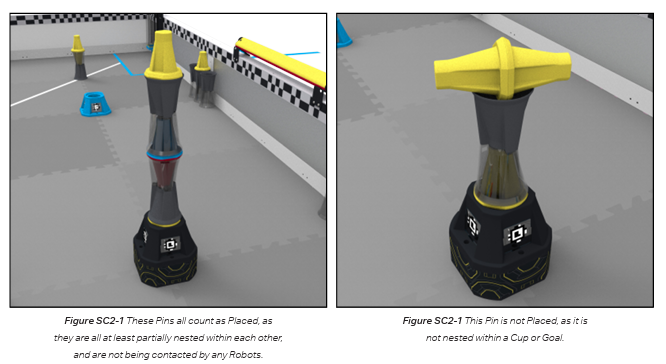
- SC2 / SC3 / SC6: Nesting includes the opening of a Cup or Goal. Robot contact alone does not negate otherwise valid placement. Apply the visible-half and ownership criteria for scoring. Any Robot part extending into the defined Midfield volume meets SC6; its footprint need not be fully inside.
- SG10: For Match Affecting evaluation, removal of 1–3 Pins in an interaction uses 10 points per Pin; removal of 4 or more uses 50 combined. Subtract this value from the offending Alliance's final score to assess whether the outcome changes; do not add it to the actual score. The referee estimates counts. Intentional, strategic, egregious, and repeated violations retain the manual's additional consequences. This replaces v1.1's 15-point-margin provision.
- SG11 / SG13 / GG4: In V5RC, introduce Match Loads through your Alliance-colored Loaders during driver control, via the top or back, separately or nested. Momentary student/Robot contact with the object during introduction is permitted; students cannot recontact it after release. Removal is through the bottom. Do not add or remove objects at opposing-colored Loaders. Follow GG4's field-reaching exceptions and safety rules. SG11's former custom penalty schedule is removed.
- Skills, RSC3: The blanket rule excluding Pins touching a Robot is removed. That does not make every contacted Pin score: placement, visible-half, color/location and ownership conditions still apply. Point denominations are unchanged.
- Possession: Plowing is no longer a defined status. Full Robot support or maintained control during movement in all directions establishes Possession. Floor pushing that loses control in a direction can fall outside Possession even with a concave face. The one-Pin/one-Cup possession limit remains.
VEX U has separate provisions: consult its changed VUG4/VUG6 and removal of VUG7. Do not substitute V5RC AWP criteria for VEX U.
Override v1.1 — What We Know 📚
Verifying Community Claims About Override
In the first month after a manual drops, the V5RC community generates a lot of strategy content — YouTube videos, Reddit threads, Discord messages, and other teams' notebooks. Some of it is excellent. Some of it cites rules that don't exist or paraphrases incorrectly under deadline pressure. The pattern that protects you is to verify rule numbers against the manual PDF before building around them.
If a source says "Rule R-something says X," open the manual and search for that rule number. If it isn't in the manual, the citation is wrong regardless of how confident the source sounded. If the rule exists, read what it actually says — the source may have paraphrased correctly, or may have overreached.
Spartan's Running List of Unverified Claims
Things we've heard from community sources that don't match the current manual, or that we haven't confirmed yet. This list grows during the season — when a student or coach encounters a claim that doesn't match the manual, add it here.
| Claim We've Heard | Source Type | Status vs v1.1 (verified against manual) |
|---|---|---|
| "R23 bans anodizing and dyeing" | YouTube influencer | Substantively correct — R23 exists. Headline is "Visual decorations are allowed," but R23a explicitly prohibits anodizing/painting/dyeing/changing the color of any legal VEX part. We initially missed this; verified against the manual after re-reading. |
| v1.1 through September 9 / v2.0 Worlds-qualifying context: "AWP requires scoring 7 pins" Standard events from September 10: six Scored Pins and two qualifying Goals instead; all other SC8 conditions apply. Check complete requirements. | YouTube influencer | v1.1 through September 9 / v2.0 Worlds-qualifying context: Correct (with caveats) — SC8 requires 7 Pins Scored for the Alliance and 3 Goals with 2+ Pins each and neither Robot touching the Field Perimeter and no Auton Violations. The 7-pin number is right; the rule has three other concurrent conditions worth knowing. Important nuance: Pins/Goals on the opposing side of the Autonomous Line don't count toward AWP — design your auton routes to keep scoring on your own side. Standard events from September 10: six Scored Pins and two qualifying Goals instead; all other SC8 conditions apply. Check complete requirements. |
| "PTO between intake and lift bypasses R11" | YouTube influencer | Wrong framing — the mechanism is legal (R11 only governs the drivetrain motors — the manual's “Subsystem 2”; non-drive PTOs aren't restricted), but "bypassing" isn't the right word because R11 doesn't apply to manipulator (Subsystem 3) motors. Practical question for our team: complexity vs. payoff under the 1+1 possession limit. |
The Five Things That Matter Most
If you only read one paragraph: most of what we speculated before the manual was right. Five things shifted enough to change site framing and team strategy.
- PTOs from drivetrain are explicitly prohibited (R11b). You cannot recover drivetrain motors mid-match for the lift via power-takeoff or differentials. The PTO trick that some teams have used in past seasons is dead in Override.
- Two power caps, not one. The drivetrain caps at 55W (R11a — the manual's “Subsystem 2”). Total robot motor power caps at 88W (R10a). With a 4×11W blue drive (44W), you have 44W of headroom for arm + manipulator + accessories.
- Pins score per half, not per pin (SC3). Each pin has two halves. A half scores if it's either uncovered, or covered by the transparent half of a cup. A single pin can score both halves (10 pts) or just one (5 pts) depending on cup orientation.
- AprilTags ARE in the manual. The reveal video on April 24 said all 9 goals have AprilTags, and v1.1 confirms it: Appendix A (page A16, "AprilTag Numbering/Locations") shows the goal AprilTags, numbered 0 (center) through 4 for each alliance. Design your vision pipeline around the published tag IDs.
- Defensive descoring is heavily restricted (SG9, SG10). Opposing-alliance goals can't be touched at all. Neutral and opposing goals can't have objects removed from them. Defensive denial via descoring is much weaker than expected.
Status Legend
| CONFIRMED | Manual confirms the brief's pre-manual claim, often with new detail. |
| NEW DETAIL | Manual gives specifics (dimensions, exact wording, mechanics) the brief speculated about loosely. |
| CORRECTED | Brief had it directionally right but the manual's framing or mechanics differ. Adjust strategy. |
| WRONG | Brief speculation contradicted by manual. Plan changes. |
| PENDING | Manual leaves ambiguous, contradicts itself, or is silent. Watch the VEX Q&A. |
Field & Match Structure 🎯
| Element | Count & Layout | Manual Cite | Status |
|---|---|---|---|
| Field size | 12′×12′ square | Section 2 Primer | CONFIRMED |
| Alliances | 2 alliances (red, blue), 2 teams each | Section 2 Primer | CONFIRMED |
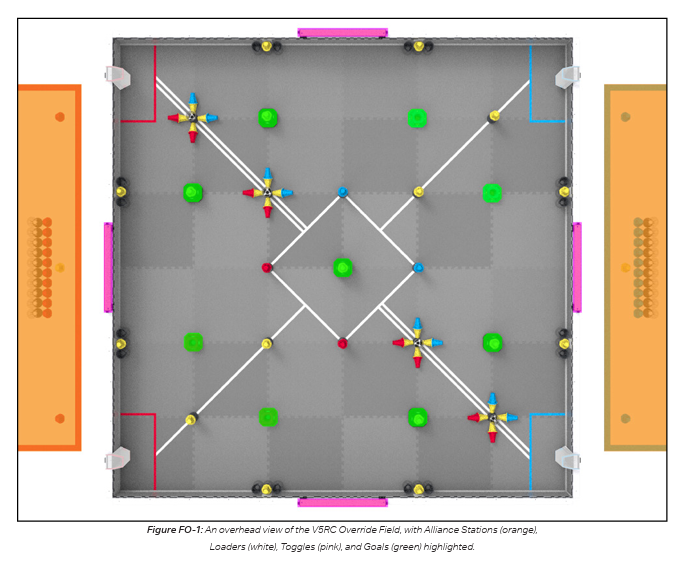
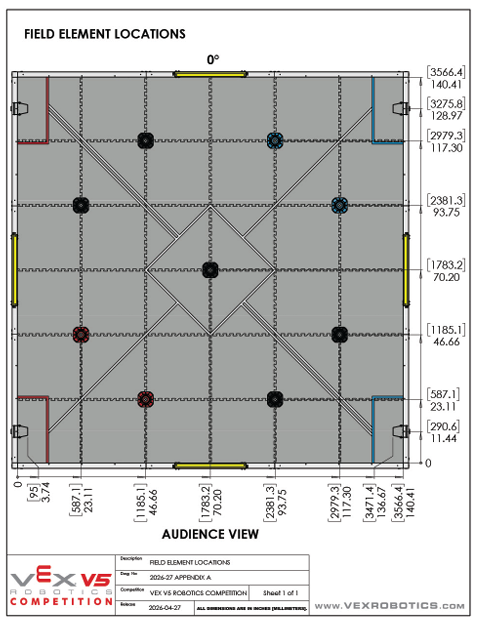
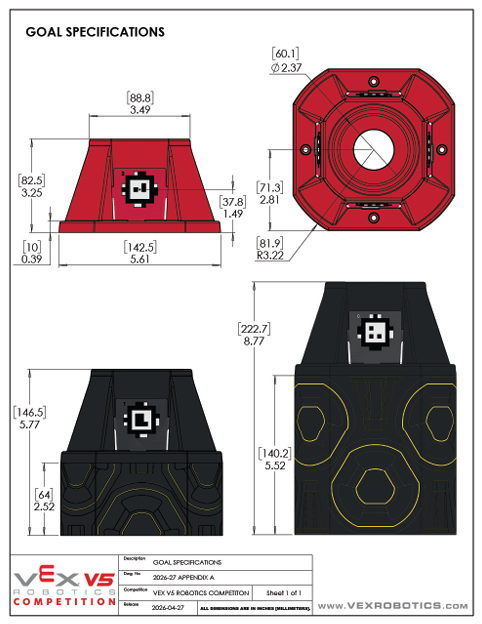
| Goals | 9 total. 4 alliance (3.25″/82.5mm) + 4 short neutral in quadrants (5.8″/146.5mm) + 1 tall center neutral (8.7″/222.7mm). All octagonal. | Glossary p B5 | CORRECTED |
| Toggles | 4 toggles, one per quadrant | Field Overview p9 | CONFIRMED |
| Match length | 15s autonomous + 1:45 driver controlled = 2:00 total | Section 2 Primer; Match table B7 | CONFIRMED |
| Endgame window | Last 10 seconds. Glossary defines "Endgame" this way; SG12 governs midfield rules. | Glossary; SG12 | PENDING |
- Endgame timing = 10 seconds (resolved). The Glossary and SG12 use 10s; an earlier GDC-letter typo said "Final 20 Seconds." v1.1's philosophy letter now reads "Final 10 Seconds," so the contradiction is gone — plan for 10 seconds.
- Toggle length (656.2mm vs 660.2mm). The Glossary toggle entry says 25.8″ / 656.2 mm long; Appendix A Figure A8 (engineering drawing) says 25.99″ / 660.2 mm. The Glossary appears to round 25.99 incorrectly. Use 660.2 mm — engineering drawings win for CAD work.
- Goal heights (5.8/8.7 vs 5.77/8.77). The Glossary rounds short-neutral to 5.8″ and tall-center to 8.7″; Figure A7 shows 5.77″ / 8.77″ (146.5 mm / 222.7 mm). Use the Figure A7 numbers for CAD; the rounded forms are fine for prose.
Goal Layout in Detail
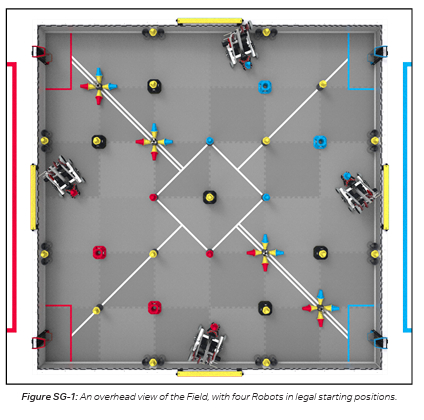
The brief earlier lumped goals as "5 neutral + 2 red + 2 blue." Manual's actual layout (Glossary "Quadrant" p B9):
- Each of 4 quadrants contains: 1 alliance-colored goal (red OR blue, whichever is the alliance for that quadrant) + 1 short neutral goal + 1 toggle.
- Alliance-colored goals: 4 total (2 red, 2 blue), one per quadrant.
- Short neutral goals: 4 total, one per quadrant.
- Tall center goal: 1, in the midfield (not in any quadrant). This is the goal whose yellow-pin points are claimed by the endgame winner per SG12.
Match Loads (Per Alliance)
| Item | Per Alliance | Per Robot Preload |
|---|---|---|
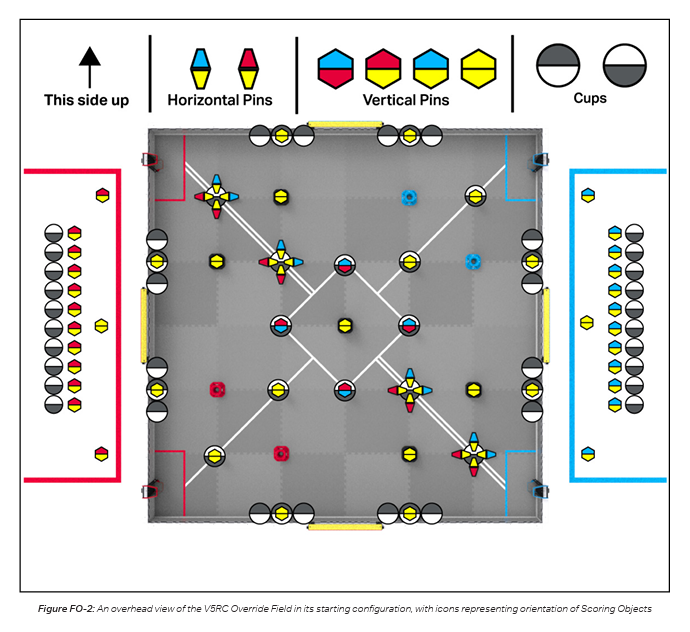
| Cups | 10 (or 20 across both alliances) | 0 (introduced via loaders) |
| Pins | 11 total: 10 alliance-colored + 1 yellow/yellow | 1 alliance-colored pin (SG5) |
Note: Match loads are per alliance, shared between the 2 robots, not per individual robot.
Game Elements 🤛
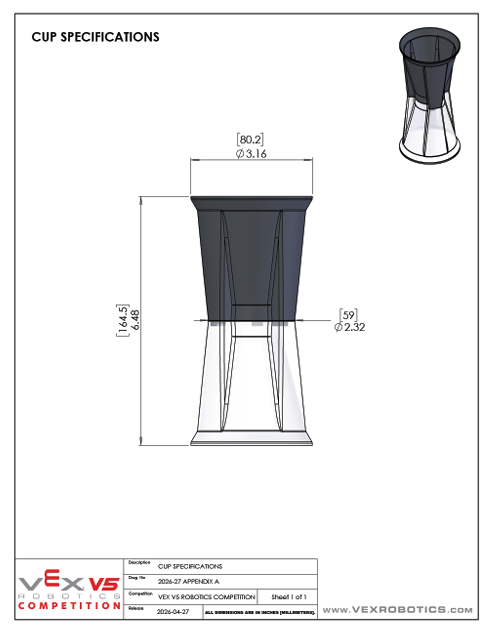
Cups (56 Total)
| Property | Value | Source |
|---|---|---|
| Shape | Hollow hourglass | Glossary p B3 CONFIRMED |
| Diameter | ~3.15″ (80mm) | Glossary p B3 NEW DETAIL |
| Height | 6.5″ (164.5mm) | Glossary p B3 NEW DETAIL |
| Halves | 1 transparent + 1 opaque | Glossary p B3 CONFIRMED |
| Field starting setup | 36 on field (24 gray-side-up, 12 clear-side-up); 20 match loads (10 per alliance) | Field Overview NEW DETAIL |
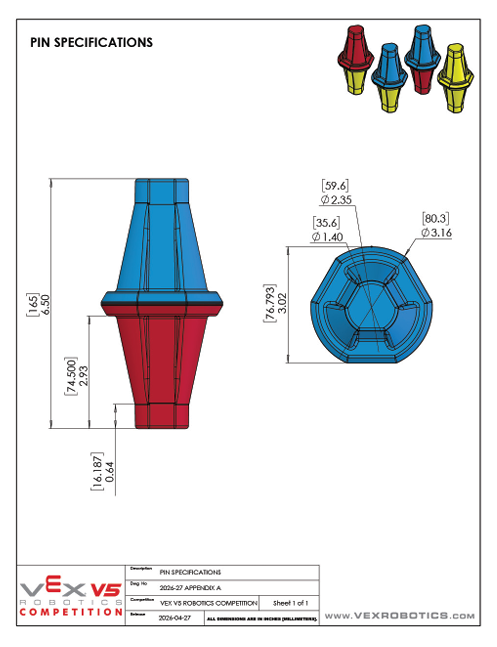
Pins (63 Total)
| Property | Value | Source |
|---|---|---|
| Diameter | ~1.6″ (40mm) | Glossary p B7 NEW DETAIL |
| Height | 6.5″ (165mm) — same as cup | Glossary p B7 NEW DETAIL |
| Halves | 2 halves per pin (each scores independently) | Glossary p B7 NEW DETAIL |
| Color combos | 20 red/yellow + 20 blue/yellow + 19 yellow/yellow + 4 red/blue | Field Overview p9 CONFIRMED |
Possession Limit (SG6)
Each robot can hold a maximum of one cup AND one pin at any time during the match. Through September 9, v1.1 uses Plowing terminology. From September 10, apply the revised Possession definition in the transition section; floor pushing is not automatically Possession (SG6.a).
| Possession Type | Allowed? |
|---|---|
| 1 pin in a gripper | Yes |
| 1 cup in a gripper | Yes |
| 1 pin + 1 cup simultaneously (separate grippers or one stacked on the other) | Yes |
| 2 pins held actively | No |
| 2 cups held actively | No |
| Pushing objects without Possession (apply the date-specific definition) | Yes |
Scoring 🏆
The Per-Half Scoring Rule (SC3)
The brief originally said "visible pin = 5 pts." The manual is more precise: each pin has two halves, and each half scores independently.
- The half is not covered by a cup, OR
- The half is covered by the transparent portion of a cup (visibility shows through).
Pin Half Point Values
| Half Color | Score | Notes |
|---|---|---|
| Red half (visible) | 5 pts for red alliance | Direct alliance scoring |
| Blue half (visible) | 5 pts for blue alliance | Direct alliance scoring |
| Yellow half (visible) | 0 pts default; +10 pts if owned by toggle | 62% of all pin halves are yellow — toggles dominate the scoring math |
Single-Pin Scoring Examples
Take a single red/yellow pin (one red half, one yellow half) placed in a goal:
| Configuration | Red Half | Yellow Half | Total to Red |
|---|---|---|---|
| Bare pin, no cup | 5 pts | 0 pts (no toggle) | 5 pts |
| Cup on pin, transparent over yellow | 5 pts (uncovered) | 0 pts (no toggle, but visible) | 5 pts |
| Cup on pin, opaque over yellow | 5 pts (uncovered) | 0 pts (suppressed) | 5 pts |
| Bare pin, red toggle active in quadrant | 5 pts | +10 pts (red claims yellow) | 15 pts |
| Cup on pin, transparent over yellow, red toggle active | 5 pts (uncovered) | +10 pts (red claims, visible) | 15 pts |
| Cup on pin, opaque over yellow, red toggle active | 5 pts (uncovered) | 0 pts (suppressed despite toggle) | 5 pts |
The Toggle Mechanic
Each of the 4 quadrants has a Toggle. Toggles change which alliance owns the yellow halves of pins placed on goals in that quadrant.
| Toggle State | Effect on Yellow Halves in That Quadrant |
|---|---|
| Yellow (default / unclaimed) | 0 pts to either alliance |
| Red | +10 pts each to red alliance per visible yellow half |
| Blue | +10 pts each to blue alliance per visible yellow half |
Bonuses
| Bonus | Value | How Earned |
|---|---|---|
| Autonomous Bonus | 12 pts | Awarded to alliance with higher auto score. Tied auto = 6 pts each. |
| AWP (Auto Win Point) | 1 ranking point | See AWP requirements below (SC8) |
| Midfield Endgame Bonus | +8 pts per robot inside midfield boundary at clock-zero | SC6 |
| Center Goal Yellow Claim | All yellow-pin points on center goal | Claimed by alliance with most robots inside midfield boundary at clock-zero (SC5b, robots-in-Midfield per SC6) |
AWP Requirements (SC8)
Use the SC8 event/date requirements above: standard events switch to six/two on September 10; Worlds-qualifying events use seven/three. Scored status, goal minimums, Autonomous-side exclusions, perimeter clearance, and no Autonomous Violations all apply.
Robot Constraints ⚙
Motor Power Caps
| Rule | Cap | Applies To | Status |
|---|---|---|---|
| R10a | 88W total across all robot motors | Every motor on the robot, summed | NEW DETAIL |
| R11a | 55W on Subsystem 1 (drivetrain) | Motors that propel the chassis | CONFIRMED |
| R11b | No PTO from drivetrain to other subsystems | Power-takeoff and differential power explicitly prohibited | NEW DETAIL |
R23a — No Anodizing, Painting, or Dyeing
This is a constraint that surprises some teams. R23 permits visual decorations, but R23a explicitly prohibits "anodizing, painting, dyeing or changing the color of any legal VEX part." If your design plan includes color-coded subsystems via dyed plastic or anodized aluminum, that's a rule violation at inspection — the parts must be returned to their original VEX color.
Expansion Limits
| Rule | Limit | When Active |
|---|---|---|
| R3 + SG1a | Starting envelope 18″×18″×18″ | Match start, before robot moves |
| SG2 | Horizontal expansion ≤24″×24″ | All match (always) |
| SG3 | Vertical expansion ≤50″ | Pre-endgame (first 1:50 of match) |
| SG12 | Vertical expansion limited to ≈ starting height (soft limit) | Any robot at least partially in the Midfield during the endgame (last 10s); verbal warning before a Violation |
Connector Rules
The brief speculated about "PTO carve-outs" and "half-motor counting rules." The manual is unambiguous on PTO: R11b states that motors used in the drivetrain subsystem "cannot provide power to any mechanism that is not a part of Subsystem 1" — i.e., drivetrain motors may only drive the base, which rules out power-takeoff / differential power to other mechanisms. Half motors (5.5W) count toward both R10a (88W total) and R11a (55W drivetrain) at their full 5.5W rating.
Interaction Limits 🚫
What You Cannot Do
| Rule | Restriction | Effect |
|---|---|---|
| SG9 | No interaction at all with opposing-alliance goals | You cannot touch a red goal as a blue robot, even to reposition or block. Hands off entirely. |
| SG10 | No removal of objects from neutral or opposing goals | If a pin is on a neutral goal, you cannot pluck it off. Even if it's your alliance color, once it's placed on a neutral goal, it stays. |
What You Can Do
| Action | Allowed Where | Manual Cite |
|---|---|---|
| Place your alliance pins on alliance OR neutral goals | Your alliance goals; any neutral goal (in quadrants or midfield) | Default (SC1) |
| Place cups on goals (your alliance, neutral, or opposing) | Wait, no — opposing goals are still off-limits per SG9 | SG9, SG10 |
| Defensive cup placement on neutrals | Neutral goals (in your or opposing quadrants) | SG10 permits adding |
| Toggle a quadrant's color | Any quadrant's toggle | Default |
| Push/contact opposing robots in the midfield endgame | Midfield zone, last 10 seconds | SG12.2 explicitly authorizes "vigorous interactions" |
Open Questions & Q&A Watchlist ❓
High-Priority Open Items
Lower-Priority Open Items
- Match-load loader mechanics. Manual confirms loaders exist and that elements can be introduced via loaders or together. The exact loader sequence (when can the second wave be introduced? Is there a delay?) is not fully specified.
- Skills format details. Section 3 describes Driving Skills + Autonomous Coding Skills (each 1 minute, two attempts each). GPS code strip required for Autonomous Coding Skills only. Specific scoring rules for skills matches not fully detailed.
- Historical v1.1 question: penalty schedule for SG9/SG10/SG12 violations. Consult the official violation notes; the v2.0 SG10 calculation is summarized in the dated transition section above.
- Center-goal yellow claim adjudication. When both alliances have the same number of robots in the midfield boundary, who gets the yellow points on the center goal? Tie-breaker not specified.
Errata-Watch (Likely v0.2 Updates)
Things we expect to be corrected or clarified in subsequent manual versions:
- The 10s vs 20s endgame contradiction — resolved as of v1.1 (now 10s throughout).
- AprilTag specifications — now shown in Appendix A (A16); tag IDs 0–4 per alliance. Watch Q&A for FOV/mounting detail.
- Possible errata on field setup quantities (24 gray-up + 12 clear-up cups split needs sanity check).
Cross-Refs & Strategic Implications 🔗
Rule → Site Page Cross-Reference
| Rule | Where It's Cited On the Site |
|---|---|
| R10a (88W total) | override-drivetrain-config, advanced-robot, mechanism-dr4b, onshape-drivetrain, tp-meta |
| R11a (55W drivetrain) | override-drivetrain-config, advanced-robot, mechanism-claw, all 5 meta pages, mechanism-chain-bar, onshape-drivetrain |
| R11b (PTO prohibition) | mechanism-pto, mechanism-dr4b, onshape-drivetrain, all 5 meta pages |
| SC3 (per-half pin scoring) | mechanism-claw § Per-Half Pin Scoring, advanced-robot § Pneumatics |
| SC8 (AWP) | advanced-robot § Auton Template |
| SG6 (1-pin + 1-cup possession) | mechanism-claw, advanced-robot § Manipulator |
| SG9, SG10 (interaction limits) | mechanism-claw § Defensive Cup Placement |
| SG12 (midfield endgame) | override-endgame, mechanism-climbing (callout), advanced-robot § Drive, endgame-mechanisms (callout) |
Strategic Implications — What This All Means
For Mechanism Design
- 1+1 possession kills accumulators. Pick single-grip or dual-grip per the Override Manipulator Deep Dive.
- Cup orientation affects scoring. The opaque half can suppress yellow halves — this is both a problem (when accidentally placed wrong) and a tool (when used defensively on neutral goals).
- No PTO recovery. Don't plan a mechanism that recovers drivetrain motors mid-match for the lift. Budget 88W − (drivetrain wattage) for everything else from the start.
For Drivetrain
- 4×11W blue (44W) is the canonical baseline. Leaves 11W of Subsystem 1 headroom and 44W of total-budget headroom for other subsystems. See Override Drivetrain Decision.
- Endgame pushing power matters. The midfield endgame is contact-heavy. A drivetrain with strong torque (Option B in the drivetrain guide) trades top speed for endgame survivability.
For Strategy
- Toggle control is enormously valuable. Yellow halves are 62% of pin-half count. See Override Toggle Strategy.
- Defensive plays via descoring are largely closed off. SG9/SG10 mean denial happens via toggle capture and opaque-side cup placement, not via plucking opponent pins.
- Endgame is positional, not climbing. See Override Endgame Strategy for the decision matrix.
Document Status
| Source manual | Override Game Manual v1.1, released August 6, 2026, 129 pages (initial v0.1 released April 27, 2026) |
| Last reconciled | August 21, 2026 — reconciled against Game Manual v1.1 |
| Update trigger | Future Game Manual updates (e.g., the Sept 3, 2026 Worlds-qualifying AWP update); new VEX Q&A responses |
| Maintainer | Spartan Design Robotics, Team 2822 |